Ghoulnextdoor.com

The Ghoulish Guidance Archive

Wildlife

Dear Spiffy,
I've been hearing strange noises coming from my attic every night for the last two weeks. My husband finally went up this evening to investigate and he discovered some sort of a nest! Whatever has been living up there wasn't there when Bob went up, but there's lots of stuff flung around the place: gravel, rocks, straw, a small refrigerator and small jars filled with unidentifiable substances. There were also some leathery looking ellipitcal objects and they seemed to be moving. How can we get rid of whatever is squatting in our attic? The mess up there is not to be believed! It looks worse than my teenage son's room!
-Bats in the belfry


Dear Bats,
Woof! Wah-wah-woo!
-Spiffy

TRANSLATION:

Dear Bats,
Well, aren't you lucky! You have gargoyles! Most people only WISH they had gargoyles nesting in their attics, but you actually seem to have a whole colony, with more on the way! The advantages of having gargoyles in one's home are legion, the most obvious being a diminishment in visits from door-to-door salesman and intrusive, proselytizing religious fanatics.
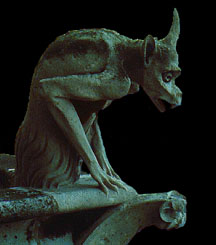
Gargoyles are wonderful roommates as long as you know how to handle them, and if I were you, I'd pick up Spiffy's Guide to Gargoyles of North America™ right away. Gargoyles value quiet and solitude, but they recognize the importance of proximity to their prey, and they often roost in attics, lofts and abandoned bell towers in cities and suburbs. They are very sensitive to loud, sharp noises and they often maim or kill people indiscriminately when startled. You must try to maintain absolute silence in and around your home at all times. (You'll want to stay clear of them during thunderstorms and I strongly advise that you leave town for the entire month of July - just be sure your homeowner's policy is paid up.)

The joys of living with gargoyles are many. They eat irritating neighbors and small, noisy children. They will make quick work of that irksome clod next door who hungrily leers at your children and endlessly yammers about meaningless minutia, while your eyes glaze over and you pray for a quick and painless death. Much as Hannibal Lecter only eats the rude, gargoyles only eat the loud and/or boring. Your home will be a haven of peace and tranquility.

Gargoyles are primarily nocturnal, though depending on the season and climate, they'll hunt in the late afternoon and early evenings as well. You will need to remove undigested remains (bones, gristle and gall bladders) from the nest while they're away (probably only three to four times a night, depending on the voracity of their appetites), and while this may be a mildly unpleasant task, try to think of it as just a large bird cage, with really huge, murderous, leathery birds. Believe me, the benefits of having your very own gargoyle colony far outweigh the extra work you'll do and the minor inconvenience of the stench of decay that will occasionally permeate your home.
-Spiffy


More Wildlife

Return to the Table of Contents


The Ghoul Next Door - Night of the Living Dead 's Little Zombie

Ghoulnextdoor.com

The Ghoulish Guidance Archive

Wildlife

Dear Spiffy,
I've been hearing strange noises coming from my attic every night for the last two weeks. My husband finally went up this evening to investigate and he discovered some sort of a nest! Whatever has been living up there wasn't there when Bob went up, but there's lots of stuff flung around the place: gravel, rocks, straw, a small refrigerator and small jars filled with unidentifiable substances. There were also some leathery looking ellipitcal objects and they seemed to be moving. How can we get rid of whatever is squatting in our attic? The mess up there is not to be believed! It looks worse than my teenage son's room!
-Bats in the belfry


Dear Bats,
Woof! Wah-wah-woo!
-Spiffy

TRANSLATION:

Dear Bats,
Well, aren't you lucky! You have gargoyles! Most people only WISH they had gargoyles nesting in their attics, but you actually seem to have a whole colony, with more on the way! The advantages of having gargoyles in one's home are legion, the most obvious being a diminishment in visits from door-to-door salesman and intrusive, proselytizing religious fanatics.

Gargoyles are wonderful roommates as long as you know how to handle them, and if I were you, I'd pick up Spiffy's Guide to Gargoyles of North America™ right away. Gargoyles value quiet and solitude, but they recognize the importance of proximity to their prey, and they often roost in attics, lofts and abandoned bell towers in cities and suburbs. They are very sensitive to loud, sharp noises and they often maim or kill people indiscriminately when startled. You must try to maintain absolute silence in and around your home at all times. (You'll want to stay clear of them during thunderstorms and I strongly advise that you leave town for the entire month of July - just be sure your homeowner's policy is paid up.)

The joys of living with gargoyles are many. They eat irritating neighbors and small, noisy children. They will make quick work of that irksome clod next door who hungrily leers at your children and endlessly yammers about meaningless minutia, while your eyes glaze over and you pray for a quick and painless death. Much as Hannibal Lecter only eats the rude, gargoyles only eat the loud and/or boring. Your home will be a haven of peace and tranquility.

Gargoyles are primarily nocturnal, though depending on the season and climate, they'll hunt in the late afternoon and early evenings as well. You will need to remove undigested remains (bones, gristle and gall bladders) from the nest while they're away (probably only three to four times a night, depending on the voracity of their appetites), and while this may be a mildly unpleasant task, try to think of it as just a large bird cage, with really huge, murderous, leathery birds. Believe me, the benefits of having your very own gargoyle colony far outweigh the extra work you'll do and the minor inconvenience of the stench of decay that will occasionally permeate your home.
-Spiffy


More Wildlife

Return to the Table of Contents